How you use AI:
which type are you?
24 questions, about 4 minutes. Discover your relationship with AI, plus your hidden 2nd and 3rd faces.

Free / No sign-up / No name required
Everyone has a pattern.
Tap a card to read that type in detail.








In 4 minutes, here is what you get.
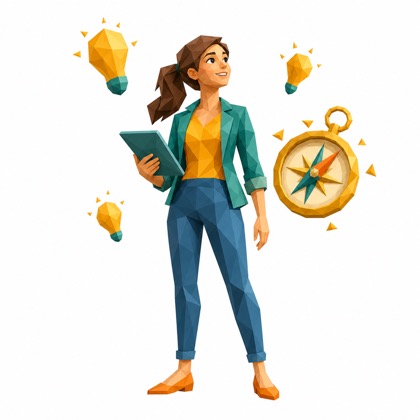
Ideas come fast, while systemization and verification run relatively low. Pair with a verification-minded partner and your ideas are far more likely to reach implementation.
- ✓Deep read on your primary type plus 2nd and 3rd faces
- ✓A 7-factor radar and what your pattern suggests
- ✓How to grow your strengths and the traps you fall into
- ✓Partner types worth combining with, and how
- ✓A personal write-up from the AI coach (free allowance: 5 per 30 days)
Sample shown. Your actual result depends on your answers.
Only three steps.
What we measure is your relationship with AI, not your personality.
None of them is better than another. The high-low pattern across the seven is what shapes how you pair with AI.
24 answers become 7 factor scores
Your responses are converted into scores for creation, bridging, self-drive, spread, systemization, verification and engagement.
Mapped onto 15 types
That factor pattern is matched against the characteristic vector of each of the 15 types. The closest one is offered as your primary type.
Second and third faces surfaced
What the top type alone can't capture shows up as runner-up types. We look at the strengths that coexist in you.
How to read the results, and what we ask of you.
Not for evaluation or selection
RELACTIS is not an HR appraisal tool. Results are hypotheses about your current collaboration style, not a ranking.
Types change
Change the tool, role or environment in mind and a different face appears. That's why we surface second and third faces.
Each organisation chooses what is shared
In anonymous mode we report only group distributions and averages. Only when an organisation chooses named mode can admins see individual-level results in team designs and reports. The setting is decided per organisation in advance.
An entry point, not a conclusion
We design every report to lead to a concrete next step.
Quiet shifts, from people who took it.
I'd written myself off as 'bad at AI'. Turns out I just had a different set of strengths. The way I pair with AI changed the very next week.
Seeing my second face finally explained why I always end up as the team's translator. Naming it as a strength made me move faster.
Our whole department took it, and we finally had one map to talk from about who to pair with and how to move forward.
Your questions, answered first.
What is RELACTIS?+
RELACTIS is an AX organisation-development service that makes how people relate to AI visible, then turns those differences into dialogue and practice. It covers Profile, Team, Studio, Action and Pulse as one continuous flow.
How is this different from a personality test?+
It reads your current relationship with AI and the strengths you express through it, rather than your personality. So the result is concrete language you can try at work today, rather than an abstract character description. Change the tool or the role, and the type that shows up can change too.
How long does it take?+
The individual check is 24 questions, about four minutes. Each one is designed to be answered in roughly ten seconds.
Are my results saved?+
Yes. A history stays in this device's browser, so you can line up a later retake and see how your outline shifts. Anonymous results are also stored on our servers for service improvement and statistics; they contain nothing that identifies you personally unless you consented and entered it yourself. If you join through an organization, your result is included in the aggregate.
Can I take it anonymously?+
Yes. You can take it without entering your name or email address. Only when you join an organization set to 'named' will you be asked to enter a name.
Will I always get one of the 15 types?+
As a rule, yes: your closest match among the 15 types is returned as your primary type. But when your answers are too evenly balanced to call, we return the result as inconclusive rather than forcing a single type, and include the closest candidate types so you still have something to work with.
We'd like to roll this out to a team.+
We provide the distribution, complement map, radar and org report, and support you through dialogue and practice design. See the Start / Shift / Enterprise programs.
Reading
More on the types
Why some colleagues never open the tool, how skeptics become your quality layer, and what the seven factors actually measure. These are essays built on the 15 types.
Start with your own type.
Free / No sign-up / No name required / ~4 min
Take it as a team, and you can talk about who pairs with whom.
Overlay everyone's results to see the spread of strengths and the gaps.