From Critic to Verifier: When AI Skepticism Is a Superpower
You've been called the skeptic, maybe worse. But the eye that spots what's wrong with AI output is exactly the skill the AI era can't run without, once it's pointed at the right target.
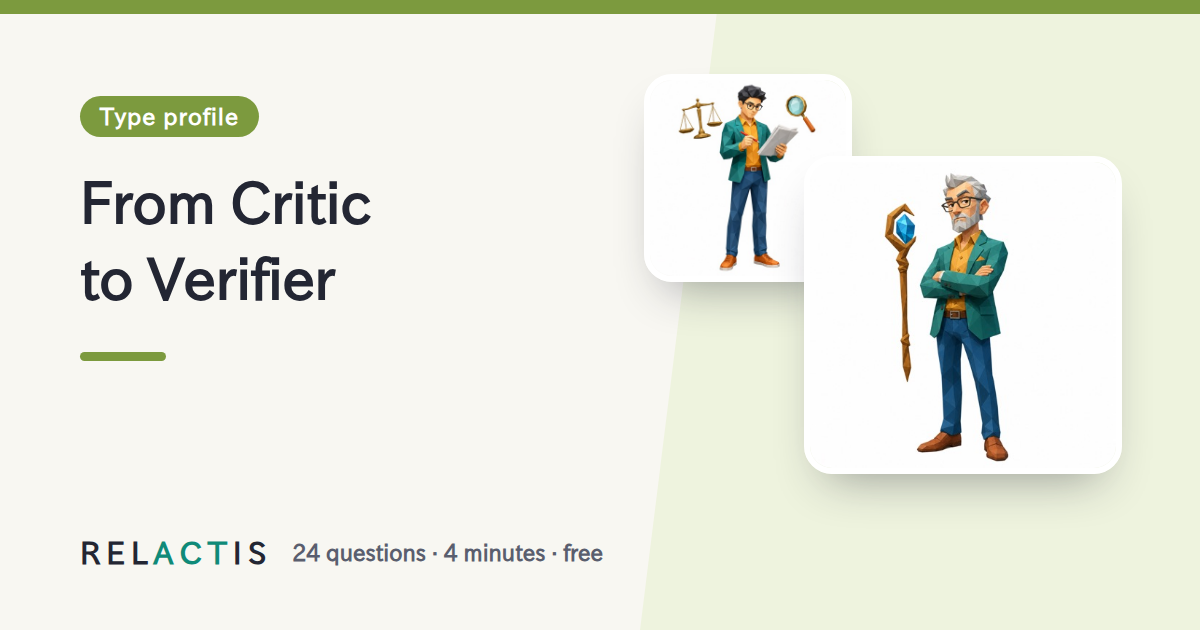
There's a particular moment in every AI conversation at work. Someone shows off a generated report, the room makes impressed noises, and you're the one squinting at paragraph three thinking, that number doesn't look right. Maybe you say it out loud. Maybe you've learned not to. Either way, you've probably picked up a label along the way: the AI skeptic.
Here's what that label flattens. On the map of the 15 AI usage types, there are two types that get called skeptics, and they share exactly the same gift while ending up in very different places. One is The Critic. The other is The Verifier. The distance between them is much smaller than it looks from the outside, and if the skeptic label has ever been yours, that distance is worth understanding.
Two skeptics, one eye
The Critic's signature line is a verdict: "AI's just not there yet." Critics talk about AI more than they use it, but the eye behind the verdict is real. They catch the flaw in the demo that everyone else claps through. They ask, in a meeting running high on excitement, whether anyone has actually checked the numbers. The way colleagues describe this type is telling: strict, but often right.
The Verifier's signature line is a question: "What's the source for this?" Verifiers don't argue about AI in the abstract. They sit with the output itself: the generated summary, the drafted email, the suspiciously tidy table, and calmly check it against reality before it goes anywhere that matters.
Notice what these two have in common. Both refuse to trust an output just because it's fluent. Both stay unmoved when everyone around them is swept up. Both believe, correctly, that confidence is not evidence. The instinct is identical. What differs is where the instinct gets applied, and that single difference changes everything about where each type ends up.
Your skepticism is often correct
Let's say the quiet part plainly: the skeptics are frequently right. Anyone who has read AI output closely knows it can be confidently, fluently wrong. Wrong in the numbers, wrong in the citations, wrong in ways that sail straight past a reader who's skimming for the gist. A workplace where nobody pushes back on that is not a mature AI workplace. It's an accident waiting for a deadline.
The Critic's profile reads less like a list of flaws than a list of assets: a genuine eye for defects, the nerve not to be swept along by inflated expectations, critique that raises the bar of the whole debate, prudence that anticipates risk before it lands, and the courage to challenge over-belief when the room has already made up its mind. None of that is resistance to progress. That is exactly the temperament you would want auditing anything important.
So if you're the skeptic, the first reframe is this: your doubt is not a character flaw to be trained out of you. It's an unrefined version of a skill that is getting more valuable, not less.
The one difference that matters: contact
Then what separates a Critic from a Verifier? Not intelligence, not standards, not personality. Contact. The Critic critiques from the sidelines; the Verifier critiques with their hands on the work.
And that difference compounds. The trap written into the Critic's profile is precise: without on-the-ground practice, the judgment loses precision year by year. The tools keep changing, and a critique formed two product generations ago slowly stops describing anything real. The eye is still sharp. It's just aimed at a target that no longer exists. Meanwhile there's a social cost that has nothing to do with being wrong: a constant "no" from someone who doesn't use the thing pushes people away, however accurate the "no" might be. You can be right and still lose the room.
The Verifier pays neither cost. Because their skepticism runs on today's outputs, it stays calibrated, they know what current tools actually get wrong, not what last year's did. And because their "no" comes with evidence attached, it lands as protection rather than posture. Same eye, kept in focus by contact.
Verification is the quality layer of the AI era
Here's the part that turns this from self-improvement into opportunity. As more people generate more drafts, reports, and code with AI, the bottleneck in knowledge work quietly shifts, from producing things to checking them. Generation is being democratized. Discernment is not. The more ordinary generating becomes, the more valuable the person who can look at an output and reliably tell sound from plausible.
That's the Verifier's whole position, and you can hear it in how colleagues talk about them: "with them checking, quality is safe." It's trust of a kind the loudest AI enthusiast in the office rarely earns. And it's built on the very trait the skeptic keeps getting scolded for.
Verifiers have their own trap, worth knowing before you head that way: getting typecast as the brake, the person who only says no. The escape route in the profile is elegant, attach "here's how it would pass" to every rejection. A no with a path attached isn't a blocker's no; it's a designer's. A Verifier who works that way is one step from designing quality in from the start, and when they pair with The Systemizer to build their checks directly into templates and workflows, the checking eye becomes something the whole team can use without them in the room.
The road from Critic to Verifier
The distance between the two types is one move: point the eye at the output instead of the topic. Practically, the Critic's own profile lays out the walk. Today, take one recent AI output, yours or a colleague's, and verify it with your own hands. Not the discourse, the artifact. Within a couple of weeks, draw one explicit line: this far is fine, from here it's not. A named boundary is worth a hundred general doubts, because someone can actually work with it. Within a month, share what you found. Your eye becomes an asset the moment its results are visible to someone other than you.
Two people make the walk shorter. A Verifier, if you know one, is essentially a senior version of you: same sensitivity, refined into method. Watching how they structure a check teaches more than any argument about AI ever will. And, unexpectedly, The Pioneer, the colleague who's always muttering "could it work like this?", turns out to be an ideal partner rather than an opponent. Pioneers produce a steady stream of new uses that badly need a skeptical eye, and a skeptical eye needs fresh material to stay sharp. The office's biggest enthusiast and its biggest doubter, quietly keeping each other honest: it's a better pairing than either of them expects.
If the skeptic label is yours
Nobody is asking you to become a believer. Enthusiasm was never the missing ingredient, contact was. Doubt that touches the work becomes verification; doubt that doesn't slowly becomes an opinion about a version of AI that no longer ships. The instinct you've been apologizing for is one of the seven factors the assessment actually measures. It's called Verification, and some people spend years trying to develop what you already have.
So the question isn't whether you're too negative about AI. It's where you currently sit on the line between The Critic and The Verifier, and the honest answer might surprise you in either direction. The four-minute assessment below will tell you. Bring your skepticism. It'll be the most qualified test-taker in the room.
Which of the 15 types are you?
24 questions · about 4 minutes · free · anonymous · no sign-up
Take the free assessment →Read next