The Quiet Abstainer: The Most Misunderstood Person in the AI Era
They said 'sounds useful' at the demo and never opened the tool. They're not lazy, and they're not against you, and the way most workplaces respond makes everything worse.
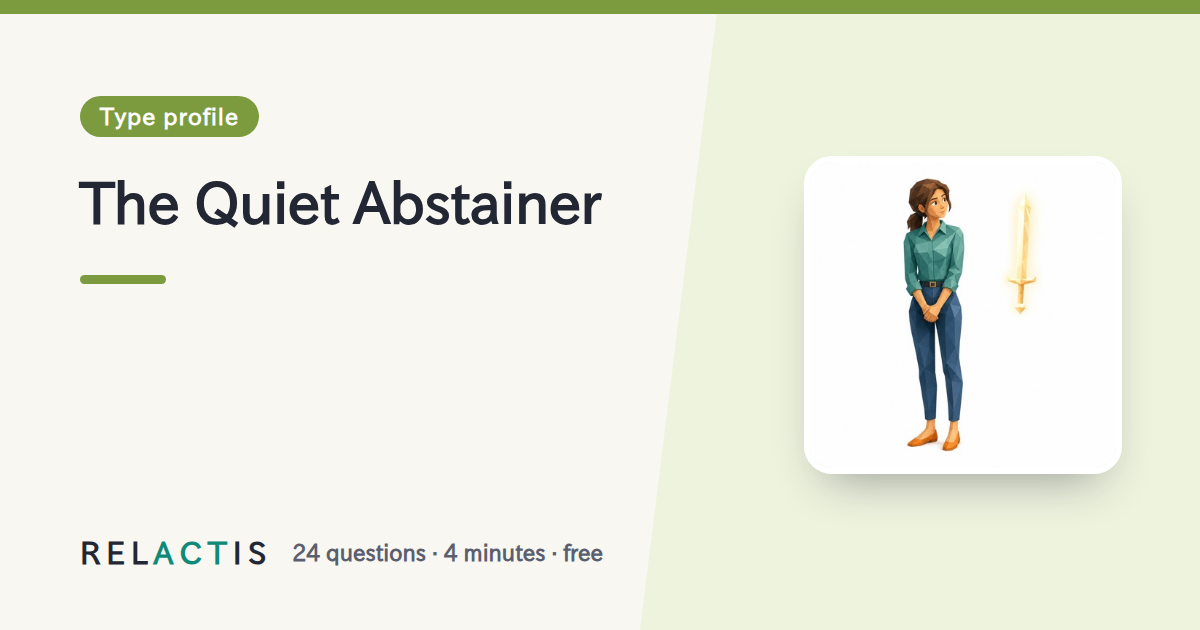
Every workplace has someone who has perfected a particular nod. You see it at the tool demo, right at the moment the presenter says "and this part will save you hours." The nod is warm, agreeable, entirely sincere. Sounds handy, it says. Then the meeting ends, the tab gets closed, and the tool is never opened. Not that week. Not that quarter.
Maybe you sit next to this person. Maybe you are this person. Either way, you already know the story the office tells about them: they're lazy, or set in their ways, or quietly hostile to the whole AI project. On the map of the 15 AI usage types, this person is called The Quiet Abstainer, and nearly everything the office believes about them is wrong.
Not opposed. Not on board. Just still.
Start with what the Quiet Abstainer is not. They are not The Critic, who has an actual position, "AI's just not there yet", and will defend it in meetings, sometimes with an uncomfortably good eye for real flaws. The Quiet Abstainer has no argument at all. Ask what they think of the new tool and you get genuine agreement: looks useful, great idea, glad we're doing this. Then nothing moves.
This isn't opposition. It's stillness, the personal version of quiet procrastination, where "I'll get to it" is completely sincere and permanently future-tense. And here's the part most adoption conversations miss: this quiet group is often the largest silent force in an organization. The loud debate happens between the enthusiasts and the skeptics, while the biggest population in the room says nothing, nods, and waits.
The waiting has reasons
Ask why people don't use AI and the popular explanations reach for dramatic words: fear, resistance, denial. But watch an actual Quiet Abstainer for a while and a different picture emerges. The waiting has structure, even when the person doing the waiting couldn't tell you what that structure is.
The first reason is prudence. Quiet Abstainers don't move just because everyone else is moving; years of workplace tool fads have taught them that "everyone's talking about it" is not, by itself, evidence. They are keenly aware that trying something new costs time and risks looking foolish, and they'd rather spend neither on hype. Sitting out a wave isn't always a character flaw. Sometimes it's pattern recognition.
The second is observation. While the enthusiasts experiment in public, the Quiet Abstainer is watching, closely. They know which colleague actually saved an afternoon and which one quietly drifted back to the old way after two weeks. They aren't ignoring the AI conversation; they're collecting evidence from the source they trust most, which is not a product page or a keynote. It's people. When a Quiet Abstainer finally moves, it won't be because a tool promised something. It will be because a person they trust showed them something real.
Underneath both runs a third thing: pace. Quiet Abstainers hold their own tempo against considerable social pressure, and they carry a latent, often accurate sense of what their work truly needs versus what's merely fashionable. They even hold one quiet advantage over the early adopters, no half-learned habits to unlearn. Their upside is untouched.
None of this makes the waiting free. The honest cost, and the trap this type falls into, is that the reason for not using AI usually goes unexamined, often the Quiet Abstainer themselves can't articulate it. No time? Anxiety? Genuinely not needed? From the inside, all three feel identical: they feel like "later." And "later," left unnamed, quietly becomes "never" while opportunities drift past and the world moves on.
Why pushing makes it worse
The standard response to a large group of non-users is pressure: a mandate, an adoption target, a manager's pointed "have you tried it yet?" With the Quiet Abstainer, this reliably backfires, and interestingly, most of their colleagues already sense it. People approach this type carefully, knowing instinctively that pushing won't help.
Here's why. Pressure gives the stillness something to be about. A person who was simply waiting for evidence now has a social reason to dig in; the agreeable nod hardens into armor, and "sounds handy" becomes a way to end conversations rather than a doorway into one. Corner a watchful, persuadable observer and you can manufacture the very resistance you were worried about. Forced marches break this type. That's not a management tip. It's just what the profile says, and what anyone who has watched it happen will confirm.
The Evangelist effect
What does work looks almost accidental. On the compatibility map, one of the Quiet Abstainer's natural companions is The Evangelist, the colleague whose entire style is "for your work, here's how you can use it." The Evangelist doesn't argue about AI in the abstract and doesn't push. They sit down next to you, with your actual task on the screen, and ride along for the first few minutes, gently loosening the hesitation instead of bulldozing it. This lands on a Quiet Abstainer like nothing else can, because it speaks their native language: not the promises of tools, but the evidence of people.
The other natural companion is The Learner, a peer at the same eye level, not an expert performing expertise. Taking a first step alongside someone who is also taking a first step removes the fear of looking slow, and stepping out together makes it far easier to keep going. There's a growth path here, and it's remarkably gentle: the profile's own prescription is one five-minute smallest use case. A Quiet Abstainer who takes that single small step is already becoming a Learner, someone who adopts happily once shown. No conversion required. Just one honest experiment, next to the right person.
If this is you
Two suggestions, straight from the type's own profile. If you've genuinely decided AI isn't for your work right now, put the reason into words, one line is enough. A named reason is a respectable, defensible position; an unnamed one reads to everyone else as avoidance, and worse, it prevents future-you from ever revisiting the decision when circumstances change. If you're not sure (and most Quiet Abstainers, honestly examined, are not sure), run the five-minute experiment. One tiny task, once. Then decide, in your own words, based on what actually happened. Either exit is fine. The only losing move is staying in "someday."
If this is your colleague
Don't ask them why they're not using AI. The honest answer is often that they can't say yet, and the question lands as an accusation. Skip the pitch entirely. If you like the tool, let them see you use it on something real, and offer (once, casually, with no follow-up) to sit together for five minutes on their task. Then let them keep their own pace. Their prudence, their watchfulness, their feel for what's actually needed: these are strengths waiting for the right moment, not deficits waiting for a training.
The Quiet Abstainer isn't the laggard in the story of AI at work. They're the most careful audience in the room, watching, weighing, waiting for evidence that respects their time. Nobody in this story needs blaming: not you, not them, not the enthusiast who moved too fast at them last quarter. Some people run ahead, some ride beside, some watch until it's real. If you want the full picture of this type, including strengths, pitfalls, and the people who bring out their best, the profile of The Quiet Abstainer is here. And if the nod in the meeting was yours, the four-minute assessment below is a good place to start putting a name to what's behind it, which, as this whole article has argued, is the step that decides everything after.
Which of the 15 types are you?
24 questions · about 4 minutes · free · anonymous · no sign-up
Take the free assessment →Read next