Who Does What with AI
You bought the licences. You ran the training. Six months on, the same four people are the only ones using it. That failure has a shape, and it is fairly consistent.
This assessment did not start from a success story. It started from a company-wide AI rollout that went unused. We deployed the tools, ran one training session for everyone, and circulated other companies' case studies with a note asking people to find something that applied to their own work. It is a normal way to do it. We got the normal result: a handful of enthusiasts, and everyone else politely unchanged.
Looking back, something was missing from that sequence. We never once asked who was suited to which part of the work. We were trying to turn everyone into the same "person who uses AI," and heading straight there.
A different organization made the same point more sharply. It built an internal school for digital skills, and its staff produced 284 workflow-improvement apps in a year using no-code tools. Anyone could build one. Yet some departments moved and others did not. We suspected several causes at the time. The one that actually mattered was whether the manager understood the point and backed it. Same effort on the floor, different outcomes, and the dividing line sat one level up.
Each part of the work suits a different person
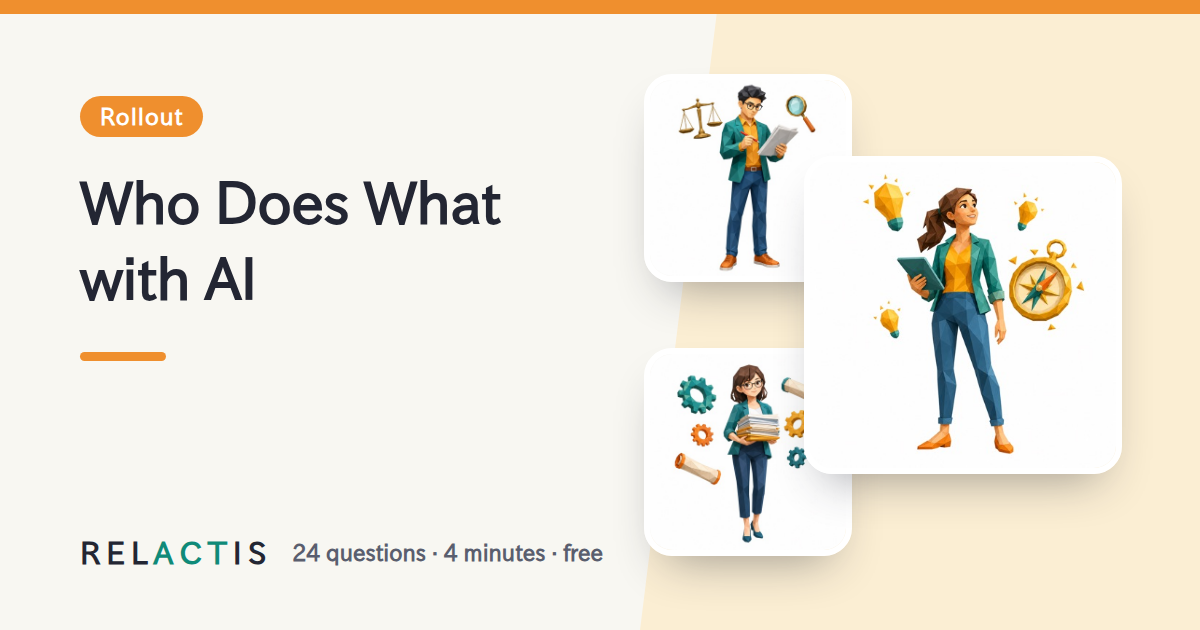
Follow AI as it actually takes hold in a team and five jobs keep showing up. Someone finds a new use, someone tries it on real work, someone checks the output, someone turns the win into something repeatable, and someone carries it to everyone else.
Each of those asks for something different. One combination that works:
- Finding: bringing in a use nobody here has tried
- Trying: running it against your own real work
- Checking: distrusting the output and stopping it before it ships
- Fixing in place: turning one win into something anyone can repeat
- Spreading: translating it into the language of someone else's job
To be clear, that is one example, not a fixed model. There is nothing magic about five of them, and the people who hold them are not locked to this order. Your organization will cut the work differently, and one person often covers two of these. The part worth keeping is narrower: a different part of the work calls for a different person.
This view earns its keep not when you count what is covered, but when you look at what nobody is holding.
- Nobody finding, and no new ideas arrive in the first place
- Nobody checking, and you get a quality incident. After one of those, every later proposal gets harder to pass
- Nobody fixing things in place, and good work stays a personal trick. It leaves when that person transfers
- Nobody spreading, and it stops inside one department, which is where this article started
When people say "our AI adoption is not going well," they are usually describing the overall temperature. The place it is actually stuck is often one of those four.
"We don't have a Pioneer" is not a dead end
Whenever we walk a room through this, the same question comes back once a gap is visible: what if nobody here can play that part?
If nobody is finding, you do not need to invent anything in-house. The shortcut is to appoint one person to bring in outside examples: find what another company has already made work, and hold it against your own processes. That is a different job from inventing, and it suits different people.
Verification is easier still, because the person is usually already there and simply not cast in the role. They are the one who says "are we sure about this?" first. Plenty of workplaces file them under obstacle. Seeing flaws is not a skill you can train into someone quickly.
What we actually do in the room is simple: ask them to find the flaws in a specific prompt. That moves the target from AI-in-general to the output in front of them, and the same person starts working as The Verifier. We wrote about that shift in more detail here.
Say this before you measure anything
All of this rests on one condition. Sorting people by role smells like performance review if you handle it badly, and the moment it does, the whole exercise stops working.
So we say three things out loud before anyone answers a question:
- No type ranks above another. Every one of these is needed, so there is no ladder here
- Nobody has to hold all of it. Trying to usually means something goes thin
- Roles move. Whoever verifies this year may be standardizing next year
That is not throat-clearing. Saying it changes the answers you get back. The moment people suspect the result feeds an evaluation, they answer the way they think you want. And the honest answers you most need are from the people who have not started and the people who doubt it, because they are the ones who decide whether this works.
One thing to move tomorrow
Take a sheet of paper and break your team's AI work into parts. It does not have to be five. Three or four is fine, cut whichever way matches how you actually work.
Then put a name against each one. Wherever your pen stops is probably where things are stuck. Before trying to raise everyone's enthusiasm, it is faster to ask whether one person can be placed there.
To see which part suits you, the assessment is 24 questions and about four minutes, free. Run it across a team and you get the distribution by role, plus whatever nobody is holding, on one page. That is what the organizational version does.
Which of the 15 types are you?
24 questions · about 4 minutes · free · anonymous · no sign-up
Take the free assessment →Read next